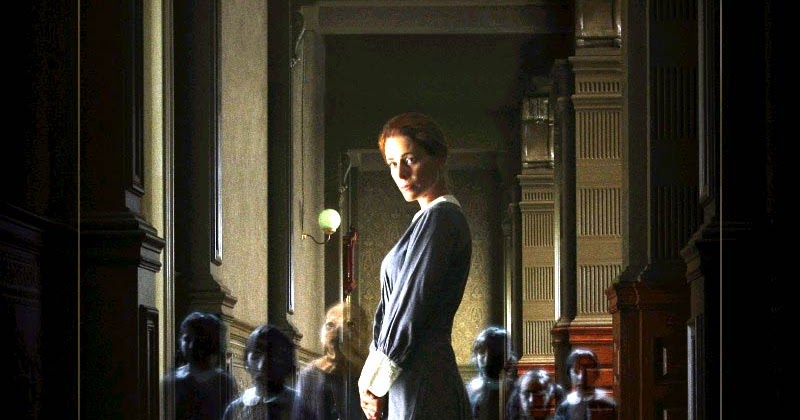
Spanish filmmaker J.A Bayona’s directional debut that marks a refreshing resurgence of the classic psychological horror genre, most notably defined by Hitchcock (Psycho, 1960) , the films of George A Romero and Polanski (Rosemary’s Baby, 1968). Tells the story of Laura (Bela Ruda), a strong and resilient woman, who returns to the orphanage where she once lived to now build a home for her husband and terminally ill adopted son. Laura’s sole purpose is to keep the legacy of the orphanage as a remaining sanctuary for the care, and unconditional support for other children with special needs. Her status, however, becomes foreseeably shaken when there is the sudden disappearance of Laura’s adopted son. Resulting in a resurfacing of dark repressed secrets that now play havoc in shifting the balance of power. Disempowerment for Laura is inevitable and a sense of loss unresolved.
Bayona’s intent here is not to callously and gratuitously shock the senses, but with some element of restrain, suspensefully exploit the codes and conventions inherent within the genre. This is without a doubt what makes contemporary Spanish psychological horror so progressive, and Bayona himself leaving an indelible mark with in it. Del toro himself talks about the conventions of Spanish horror or in this case its subgenre as described as that which is a decimation of the soul, as in the case of Laura her soul crying out for reprieve. The combination of methodical tracking shots, high and low angle camera footage and a jarring sound design, destabilises any safe and fixed position for Laura. Because it’s through her eyes that our deepest fears become imminent. For Bayona, the advent of a classic and postmodern twist on the conventions of horror here, does carry with it some momentum. The former for one personifies Laura as partial victim, partial heroine, signifying a wavering female subjectivity. In addition, via its spectacle of decay. Carrying with it a deep textural and emotional layering of narrative, that even the cold hearted could not refute.
 " VISUAL SEMIOTICS " - Decoding the language of Cinema and Media. Published by Piers Ross , Freelance Film Blogger.